
Thursday, July 9, 2026·8 min read
How translation reuse reduces documentation workload under EU Machinery Regulation 2027


Translation reuse lets manufacturers translate identical or near-identical content once, then automatically apply that approved translation across future manuals, product variants, languages, and revisions. Under EU Machinery Regulation 2023/1230, which starts applying on 20 January 2027, this matters because most of what changes in a document over its lifetime is a small edit to an otherwise stable file. Translation reuse reduces repetitive work, improves terminology consistency, shortens review cycles, and lowers the total translation cost of keeping technical documentation current.
New to the regulation? Start with our guide to which documents fall under EU Machinery Regulation 2027. This article assumes you already know what has to be translated and focuses on a narrower, more practical question: how do you avoid translating the same thing more than once?
Executive summary
- Machinery documentation changes continuously, not only before a product launches.
- Most technical content in a revised manual repeats content from the previous version.
- Translation reuse eliminates unnecessary retranslation of unchanged text.
- Reviewers see only new or modified content instead of full documents.
- Platforms such as TextUnited automate reuse through translation memory and terminology management.
Why manufacturers end up translating the same content repeatedly
Machinery documentation is rarely written once and left alone. A single product line generates instruction manuals, safety warnings, maintenance procedures, technical specifications, installation guides, and component descriptions, and each of these documents gets revisited whenever the product changes.
Product families multiply this further. A manufacturer selling five variants of the same base machine typically maintains five sets of documents that share the majority of their content: the same safety warnings, the same maintenance schedule, the same installation sequence, with only the sections describing what makes each variant different. Software-driven machinery adds another layer, since UI strings and control panel text get revised with every firmware update.
When each of these documents is treated as a standalone translation project, the same sentences get sent to translation again and again, simply because no one is comparing the new version of the file against the last one that was already approved. Over a product's life, that repetition becomes the single largest and most avoidable source of translation spend.
What translation reuse actually means
Translation reuse is a practical mechanic, not an abstract concept. Consider a single instruction: "Tighten the bolt to 25 Nm." That sentence might appear, unchanged, in the operating manual, the maintenance guide, the quick-start card, and again in the next version of each of those documents after a minor revision.
Without reuse, that sentence gets translated five separate times, by five separate translation tasks, each one going through its own review cycle. With reuse, it gets translated once. Every later appearance of that exact sentence, or one close enough to match, is filled in automatically from the approved translation and flagged for a lighter check rather than a full retranslation.
This is the mechanism behind translation memory and terminology management. What matters for EU Machinery Regulation 2027 specifically is not how translation memory works technically, but where it applies inside a documentation set that has to stay accurate, current, and translated for a decade or more.
Where translation reuse has the biggest impact
| Scenario | Reuse benefit |
|---|---|
| Product updates | Only the changed paragraphs need translation, not the whole document |
| Product variants | Shared safety and installation instructions are reused across the family |
| Annual documentation reviews | Previously approved translations carry forward automatically |
| Safety manuals | Approved warning language stays identical across every revision |
| Software and firmware releases | Existing UI strings are reused instead of retranslated from scratch |
| Service and maintenance manuals | Common procedures shared across models are translated once |
Independent research on content reuse in technical documentation gives a sense of scale: when a revised manual reuses its unchanged sections rather than resending the whole document for translation, authors and translators typically deal with only a small fraction of genuinely new content per revision, with the rest carried forward from prior approvals. Separate industry research on content reuse strategy has found that organizations applying structured reuse cut content creation time by roughly 30 to 50 percent, a saving that extends directly into translation, since every reused source segment is a segment nobody has to pay to retranslate.
Why translation reuse becomes more valuable after EU Machinery Regulation 2027
Machinery documentation under Regulation (EU) 2023/1230 is not a one-time deliverable. The EU declaration of conformity, for instance, must be continuously updated and translated into the language or languages required by the Member State where the machinery is placed on the market, made available, or put into service (Article 21(2)). The instructions for use, the safety information, and the information set out in Annex III must likewise be in a language users can easily understand, as determined by each Member State (Article 10(7)).
Machinery Regulation 2027 is exposing a documentation operations problem.
Join TextUnited for a practical session on assessing documentation readiness before the regulation takes effect, covering where teams feel the impact first, how multilingual documentation turns into a bottleneck, and a framework for evaluating whether your process can support growing compliance and language demands.
Put together, this means that every standards update, every substantial modification, and every new market a manufacturer enters can trigger a fresh translation obligation, on top of documents that were already translated once. If none of the previous approved translations are reused, each of these events gets treated as a clean-slate project, and the translation cost of staying compliant keeps climbing for as long as the product stays on the market.
Our article on the 10-year documentation obligation covers why that obligation extends well past the 20 January 2027 deadline; translation reuse is the practical mechanism that keeps the cost of meeting it from growing in step with the number of revisions.
How TextUnited helps teams reuse translations automatically
TextUnited applies translation memory and terminology management to machinery documentation so that manufacturers are not relying on someone remembering which sentences were already approved. When a revised document is uploaded, it is compared automatically against previous versions, and any segment that matches an approved translation is filled in without going back through a full translation cycle.
That reuse works alongside AI pre-translation for genuinely new content, a shared terminology database that keeps safety-critical wording consistent across languages, version comparison that isolates exactly what changed between document revisions, and collaborative review and approval workflows so reviewers see only the segments that need their attention. If you need the operational next step, see how to build a scalable translation workflow for this regulation.
For manufacturers managing the 10-year retention window discussed in our documentation obligation guide, this also produces an audit trail of what was translated, when, and against which source version, which matters if a market surveillance authority requests documentation in a language it can easily understand.
Translation reuse works across a wide range of document formats. Whether you’re translating technical manuals, Adobe InDesign files, Office documents, XML, DITA, SCORM courses, or other business content, TextUnited preserves existing translations whenever possible so teams only need to review new or updated content. Explore our supported file formats to see which document types fit your localization workflow.
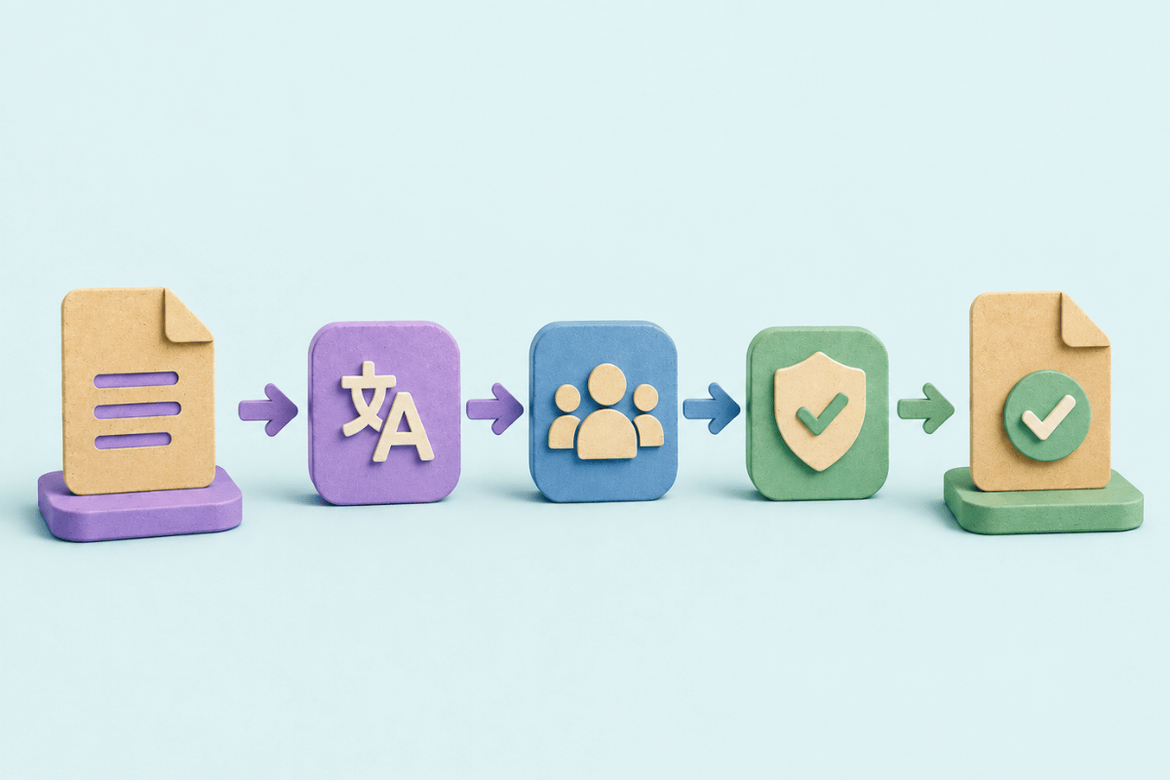
Example workflow
- A revised document is uploaded to TextUnited.
- The system compares it automatically against the previous approved version.
- Segments that match existing approved translations are reused without re-translation.
- Only new or changed content is routed to AI pre-translation or a human translator.
- Reviewers approve the new segments, working from a shorter, more focused task.
- The multilingual documentation set is published.
Ready to stop retranslating the same documentation?
See how TextUnited automatically reuses approved translations across product updates, manuals, and future revisions, with terminology that stays consistent every time.
When translation reuse delivers the highest ROI
Translation reuse pays off fastest for organizations where documentation is large, repetitive, and updated on a recurring schedule rather than written once. That typically includes manufacturers of industrial equipment, automation systems, and machinery with several product variants sharing a common documentation core. It also includes OEMs and exporters selling into multiple EU Member States, since each new market can add a language requirement to documents that are otherwise unchanged, as well as manufacturers who release firmware or software updates on a schedule independent of their documentation team's calendar.
The common thread across these cases is not the industry. It is how often the same underlying content resurfaces across documents, variants, and revisions. The more it resurfaces, the more a manufacturer pays, in translation cost and reviewer time, for not reusing what was already approved.
Key takeaways
- Documentation changes continuously across a product's life, not only before launch.
- Most technical documentation in a revision contains content that hasn't actually changed.
- Translation reuse avoids paying to translate the same identical text more than once.
- Reviewers only need to check new or modified content, not entire documents.
- Article 21(2) requires the EU declaration of conformity to stay continuously updated and translated, which makes reuse increasingly valuable the longer a product stays on the market.
- TextUnited combines translation memory, terminology management, and AI pre-translation to automate reuse while keeping terminology consistent.
This article is based on Regulation (EU) 2023/1230 of the European Parliament and of the Council of 14 June 2023 on machinery (OJ L 165, 29.6.2023), as corrected by the corrigendum of 4 July 2023, which moved the application date from 14 January 2027 to 20 January 2027.
It is intended as an operational guide for documentation and localization teams and does not constitute legal advice. Consult the full regulation text and qualified legal counsel for compliance decisions.
Sources and references
- Regulation (EU) 2023/1230 of the European Parliament and of the Council of 14 June 2023 on machinery, Article 10(7) (instructions for use and language requirements) and Article 21(2) (continuous update and translation of the EU declaration of conformity).
- Industry research on content reuse and translation cost reduction in technical documentation, including findings published by Paligo.
Frequently asked questions
Related Posts

Which documents fall under EU Machinery Regulation 2027: a plain-language guide for documentation teams

EU Machinery Regulation 2027: How to build a scalable translation workflow

EU Machinery Regulation 2027's 10-year documentation obligation: Why a one-time translation project won't be enough