
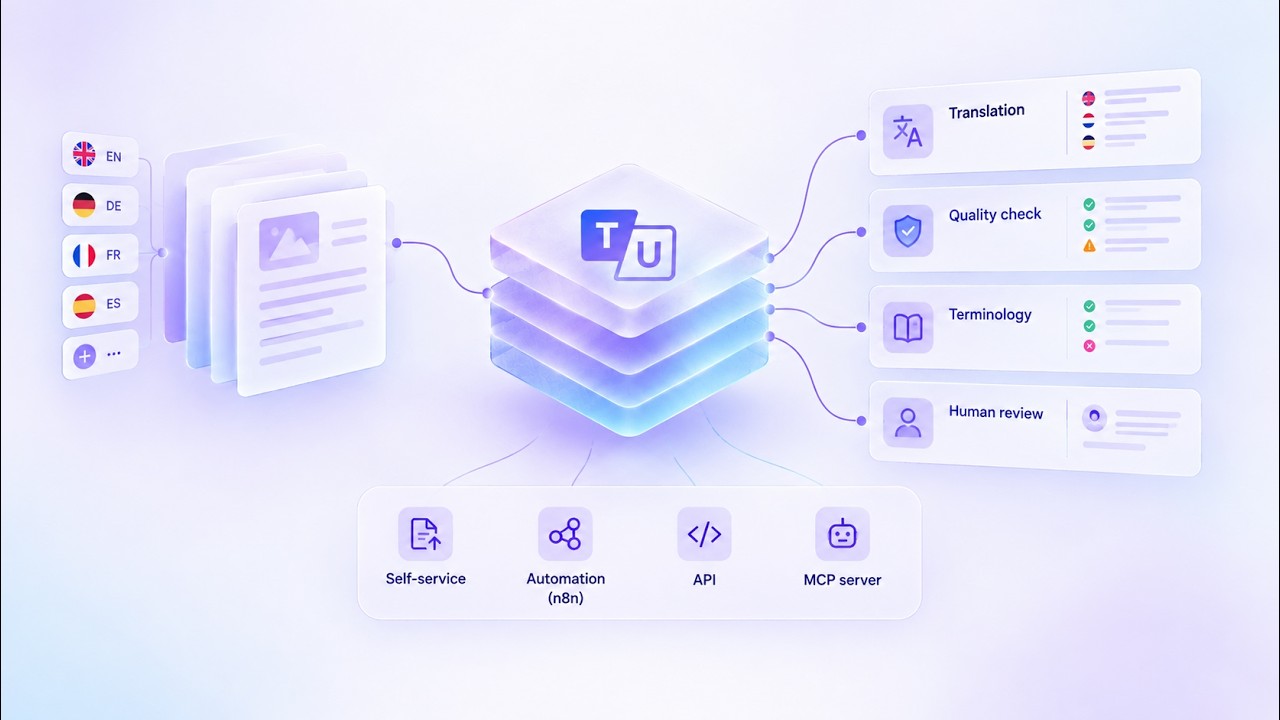
For companies whose technical content carries the cost of being wrong
Until now, you had three options. None of them fits your content today.
Somewhere in your company, someone published content they cannot read. Just because nobody on the team speaks Polish.
The grammar seems correct and the tone professional. But fluency is not evidence. Fluency hides the mistake.
You need certainty on the content that carries risk, and lower costs on the content that does not. Above all you need a way to tell which is which.
I used the files TextUnited provided. Comparing to ChatGPT translations there were significant improvements in translations done in TextUnited.
Machine only
Nothing checks the translation against the original. You find out it was wrong when a customer or a regulator does.
Send it to an agency
You get a file back and someone's word that it is correct. Agency keeps your language data to itself and you pay the full rate on every line.
Buy a TMS
The same file-in, file-out workflow, now on your own licence. Terminology still lives in a spreadsheet, quality still rests on someone's word, and the tool barely touches the systems where your content is written.
You publish into a dozen markets. This is what crosses your desk in a single quarter:
| An internal announcement | Nine languages, out today. Nobody is harmed if a comma is wrong. |
| A product page carrying a load rating | One number, and it is a liability the moment it drifts. |
| A fall-protection module | Arabic and Hindi, for people who will act on it. Arabic runs right to left. Devanagari needs more line height, or the vowel marks are cut off. Neither one gets retyped by hand. |
| A supplier catalogue in InDesign | German runs 30% longer than the English and the fixed text frames break. |
| Ten years of technical documentation | Nobody has read it since it was written. Now an AI assistant uses it. |
Each of those needs a different amount of human attention. All three treat every line the same way: a person checks everything, or nobody checks anything.